We Can Map the Brain. We Still Cannot Explain It.
How modern neuroscience is revealing unprecedented detail while the deepest questions about mechanism, consciousness, memory, and cognition remain unresolved.

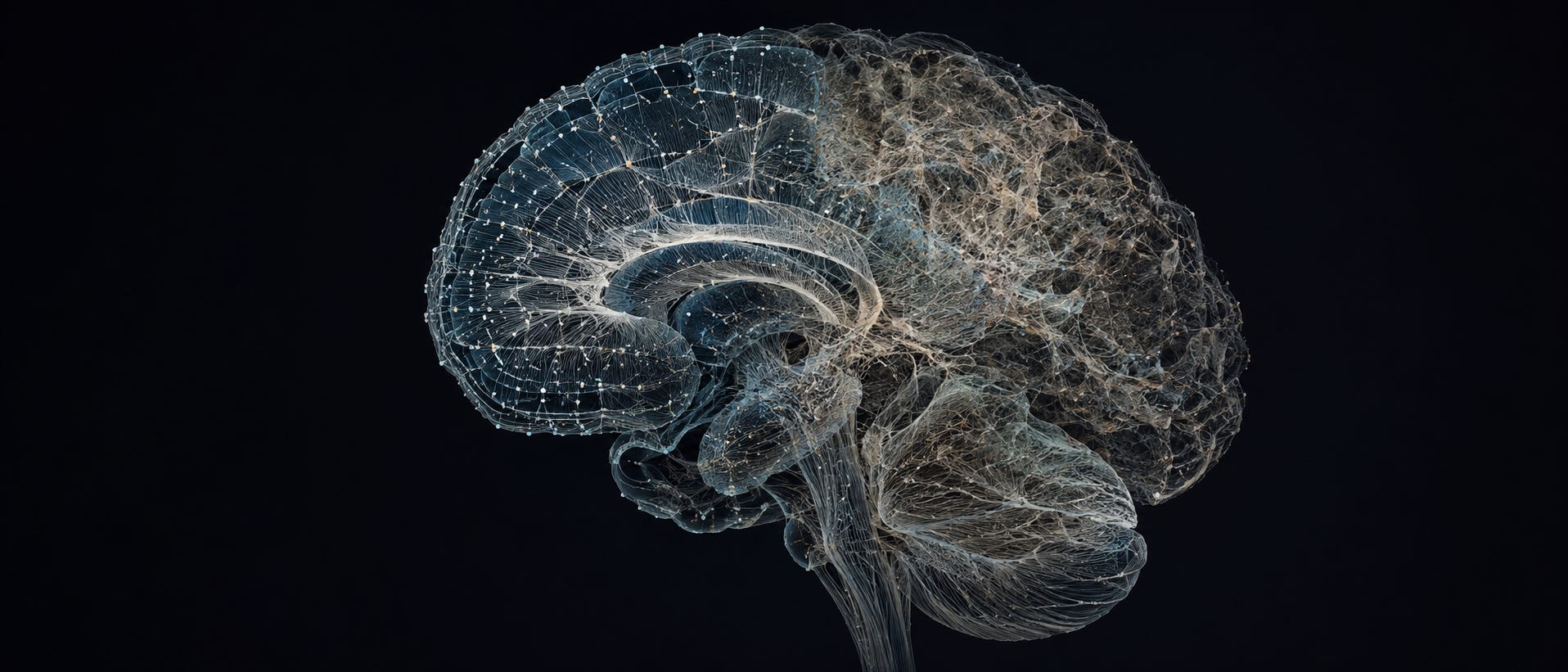
Neuroscience can record thousands of neurons at once. It can manipulate selected cell populations with light, reconstruct millions of synapses, decode intended movements, and sometimes restore limited communication to people who have lost the ability to speak.
It has produced a complete wiring diagram of an adult female fruit fly brain containing 139,255 neurons and more than 54 million synapses. The MICrONS project linked functional recordings from tens of thousands of neurons in mouse visual cortex to an electron microscopy reconstruction containing more than 200,000 cells and roughly half a billion synapses. (Nature)
These are historic achievements.

Conceptual illustration of large-scale connectome reconstruction. Mapping neural connections reveals biological structure, but structure alone does not explain the computations those circuits perform.
But even a remarkably complete map is not, by itself, an explanation.
Knowing which neurons connect does not automatically reveal what those connections compute. Predicting what an animal saw does not prove that the brain uses the same decoding rule as the scientist. Finding activity correlated with awareness does not establish that the activity produces awareness. Restoring performance on one laboratory task does not necessarily mean the original function has recovered.
This distinction matters because neuroscience is entering an era in which its measurements can look more complete than its explanations really are. The field can increasingly tell us where activity occurred, which variables can be decoded, and what changed after an intervention. Its deepest challenge is explaining how biological components jointly produce function, why those functions sometimes fail, and how they can be restored without creating new problems.
Depending on the claim being made, a problem remains unsolved when it lacks one or more of the following: a well-supported mechanistic explanation, a causal model that survives controlled perturbation, predictions that generalize beyond the data used to build the model, reliable translation to individual humans, or an intervention that restores the relevant function without unacceptable tradeoffs. No single criterion applies equally to every scientific question, but confident claims of understanding should make clear which of these standards they have actually met.
Across those standards, the brain remains profoundly unsolved.
The gap between information and mechanism
Neural activity clearly contains information. Firing rates, precise spike timing, bursts, synchrony, oscillatory phase, dendritic activity, population geometry, and neuromodulators can all carry or transform information.
The unresolved question is which of those variables are actually read and used by downstream circuits during behavior.
A successful decoder shows that information is extractable from recorded activity under the analyst’s model. A mechanism explains which variables the biological system reads, how it reads them, and how that reading changes downstream state and behavior.
The same problem appears in connectomics. A wiring diagram can reveal which neurons contact one another, but it usually does not fully specify synaptic strength, receptor composition, transmission probability, conduction delay, neuromodulatory state, plasticity history, or the network’s present dynamical state. Two anatomically similar circuits can behave differently under different chemical, metabolic, developmental, or behavioral conditions.
The brain is not static wiring. It is wiring plus state, history, timing, body, environment, and continual adaptation.
Computational descriptions still outrun biological implementation
Neuroscientists often describe brain function using concepts such as predictive coding, Bayesian inference, attractor dynamics, evidence accumulation, reinforcement learning, normalization, and internal models. These frameworks can explain important patterns in behavior and neural activity. But a computational description is not automatically a biological implementation.
Predictive-processing theories, for example, propose that higher levels generate predictions while lower levels transmit discrepancies between predictions and sensory input. There is substantial evidence for expectation-related and mismatch-related activity. Yet there is no universally accepted circuit architecture that cleanly identifies prediction units and error units across sensory systems.
A complete explanation would need to connect biophysical mechanism to circuit operation to represented variable to behavioral function. Most current theories explain only part of that chain.
Consciousness remains divided into two problems
Consciousness is often treated as one mystery. It is better separated into an empirical problem and a philosophical one.
The empirical problem asks which neural mechanisms distinguish wakefulness from unresponsive states, conscious from unconscious perception, one conscious content from another, and conscious experience from attention, memory, decision, and report. Researchers study these questions with anesthesia, brain injury, intracranial recordings, neuroimaging, stimulation, and experiments in which sensory input remains stable while reported perception changes.
Reports themselves create a confound: saying that you experienced something requires memory, decision-making, language, and motor output. Activity associated with producing a report may not be part of the experience itself.
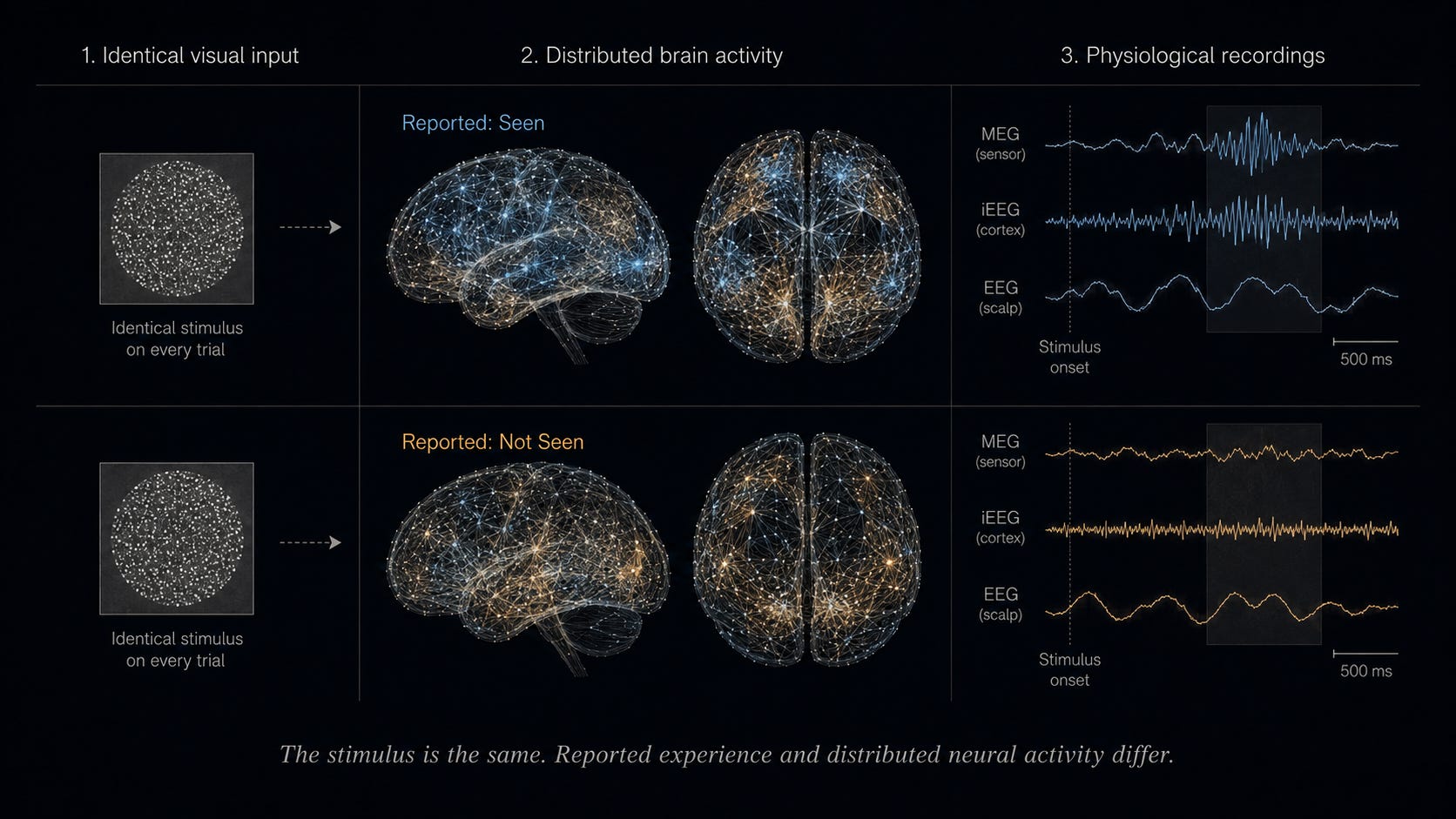
Conceptual illustration. Identical sensory input can produce different reported experiences and different patterns of distributed neural activity. The challenge is determining which neural activity is causally responsible for conscious perception rather than merely correlated with it.
A major adversarial collaboration published in 2025 tested predictions from global neuronal workspace theory and integrated information theory using fMRI, MEG, and intracranial EEG. Some predictions were supported, while important predictions from both theories were challenged. No decisive winner emerged. That is useful scientific progress. A theory can be informative even when a test exposes its limits. (Nature)
The philosophical hard problem is different. It asks why physical processing is accompanied by subjective experience at all. Why does pain feel painful? Why does red look like anything? Why is there a first-person point of view rather than information processing without experience?
Physicalism, dualism, illusionism, idealism, neutral monism, and panpsychism offer competing answers. None is an established neuroscientific conclusion. Integrated information theory attempts to identify consciousness with the intrinsic causal structure of a physical system. Its current formalization remains a contested theory rather than a demonstrated solution to subjective experience. (PLOS)
The empirical mechanisms of awareness may become increasingly tractable. Whether those mechanisms close the philosophical explanatory gap remains open.
Perception is not a copy of the world
Sensory receptors convert light, pressure, sound, chemicals, temperature, and bodily conditions into neural signals. Neuroscience understands many early stages of this process. What remains incomplete is how distributed signals become stable, meaningful percepts.
Perception depends on more than incoming data. It is shaped by prior experience, attention, context, bodily state, goals, expected consequences, and available actions. Change blindness shows that people can miss large alterations in a scene. Inattentional blindness shows that an unexpected but visible object may go unnoticed while attention is directed elsewhere. Illusions show that the brain actively constructs perceptual interpretations rather than producing literal copies of sensory input.
This leads to several versions of the binding problem. How does the brain assign color, shape, motion, and location to the correct object? How are events separated or joined across time? How does the nervous system determine that a voice, moving face, and touch belong to the same person? How are temporary abstract relationships represented, such as “person A gave object B to person C”?
Attention, recurrent processing, synchrony, oscillations, conjunctive neurons, and population geometry may all contribute. No single proposed mechanism accounts for every form of binding.
The brain must change without losing itself
Learning requires change. Memory, stable behavior, and coherent identity require continuity. The nervous system must somehow allow rapid learning while protecting established knowledge from constant interference. It must strengthen selected connections without producing runaway excitation. It must update old beliefs while preserving skills that remain useful.
Long-term potentiation, long-term depression, spike-timing-dependent plasticity, neuromodulation, structural remodeling, adaptive myelination, inhibitory regulation, and homeostatic plasticity all participate. Laboratory learning rules do not yet provide a complete account of learning during natural behavior.
Memory deepens the puzzle. Experiments have identified neuronal ensembles whose reactivation contributes to memory retrieval. Yet memories do not appear to reside in a single fixed population of permanent storage neurons. Representational drift shows that individual neuronal responses can change over time while remembered information or behavioral performance remains stable. (Nature)
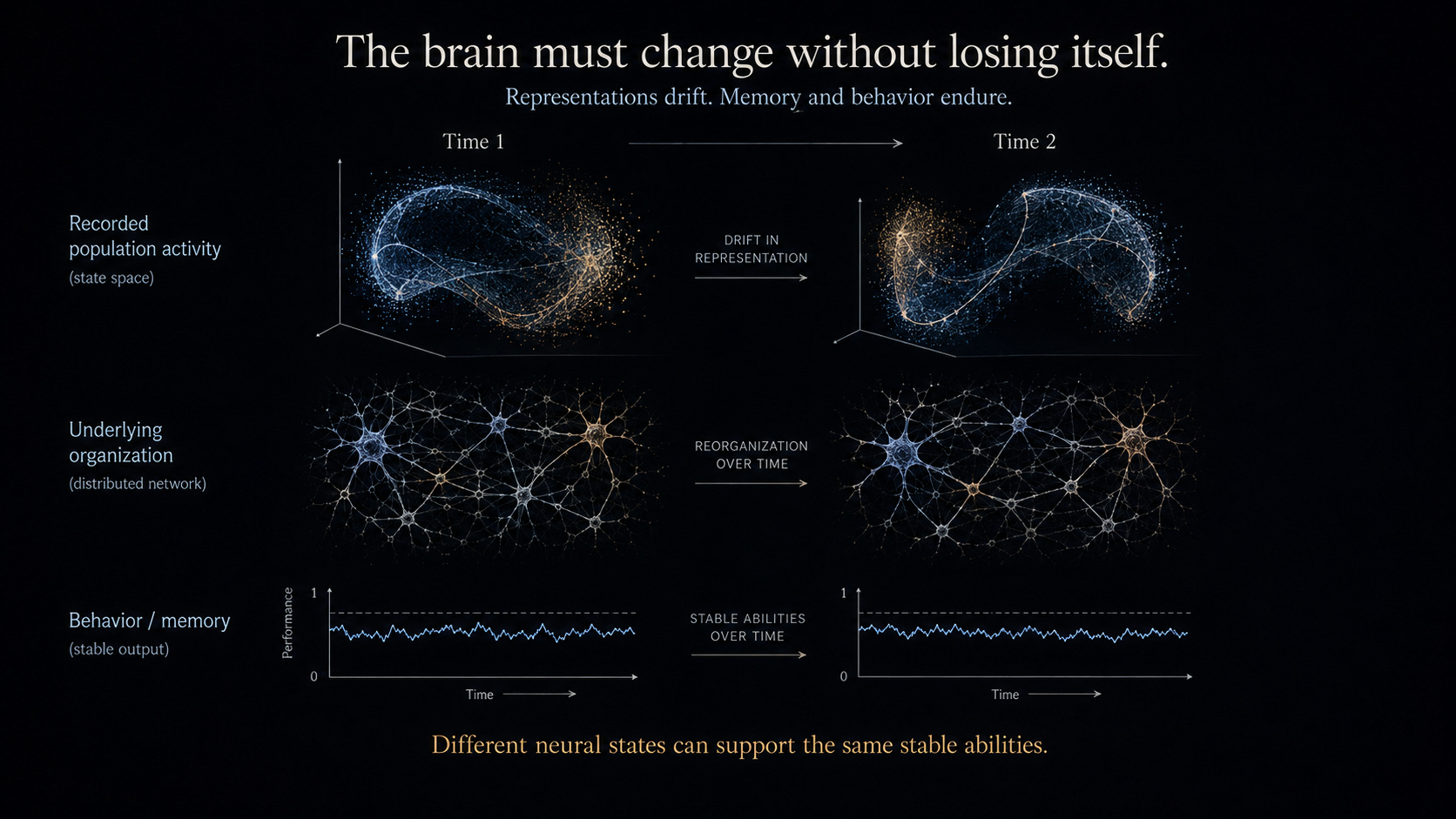
Conceptual illustration of representational drift. Neural activity patterns can reorganize over time while memory and behavior remain stable, illustrating how stable function may persist despite changing neural representations.
The real question may not be “Where is the memory?” It may be: Which changing biological properties are jointly sufficient to preserve the information required for later reconstruction?
Memory may depend on combinations of synaptic strength, dendritic structure, intrinsic excitability, gene expression, network organization, oscillatory coordination, and neuron-glia interactions. The brain may preserve organization without preserving every component.
Sleep is not merely downtime
Sleep and sleep-like states are widespread across animal lineages, yet no single accepted theory explains why evolution repeatedly preserved long periods of reduced responsiveness.
Sleep contributes to or interacts with memory consolidation, synaptic regulation, immune function, metabolic restoration, and cerebrospinal-fluid dynamics. Sleep has also been proposed to facilitate the clearance of metabolic products, although the direction and magnitude of sleep-dependent clearance remain disputed. These functions have not been unified into one accepted account. We still do not know whether sleep has one primary purpose or several partially independent ones, why NREM and REM sleep differ, whether sleep need is controlled locally or globally, or why dreaming occurs. (Nature)
Anesthesia makes the mystery sharper. Different anesthetic drugs act at different molecular targets but can produce overlapping outcomes such as unresponsiveness, amnesia, immobility, analgesia, and loss or alteration of conscious experience. These components can dissociate.
Anesthesia is not one simple state, and it is not identical to natural sleep. There appears to be no single anatomical consciousness switch. Current evidence points toward distributed changes across cortical, thalamic, hypothalamic, and brainstem systems.
Neurons are not acting alone
The traditional image of the brain places neurons at the center and treats glia as biological support infrastructure. That picture is becoming inadequate.
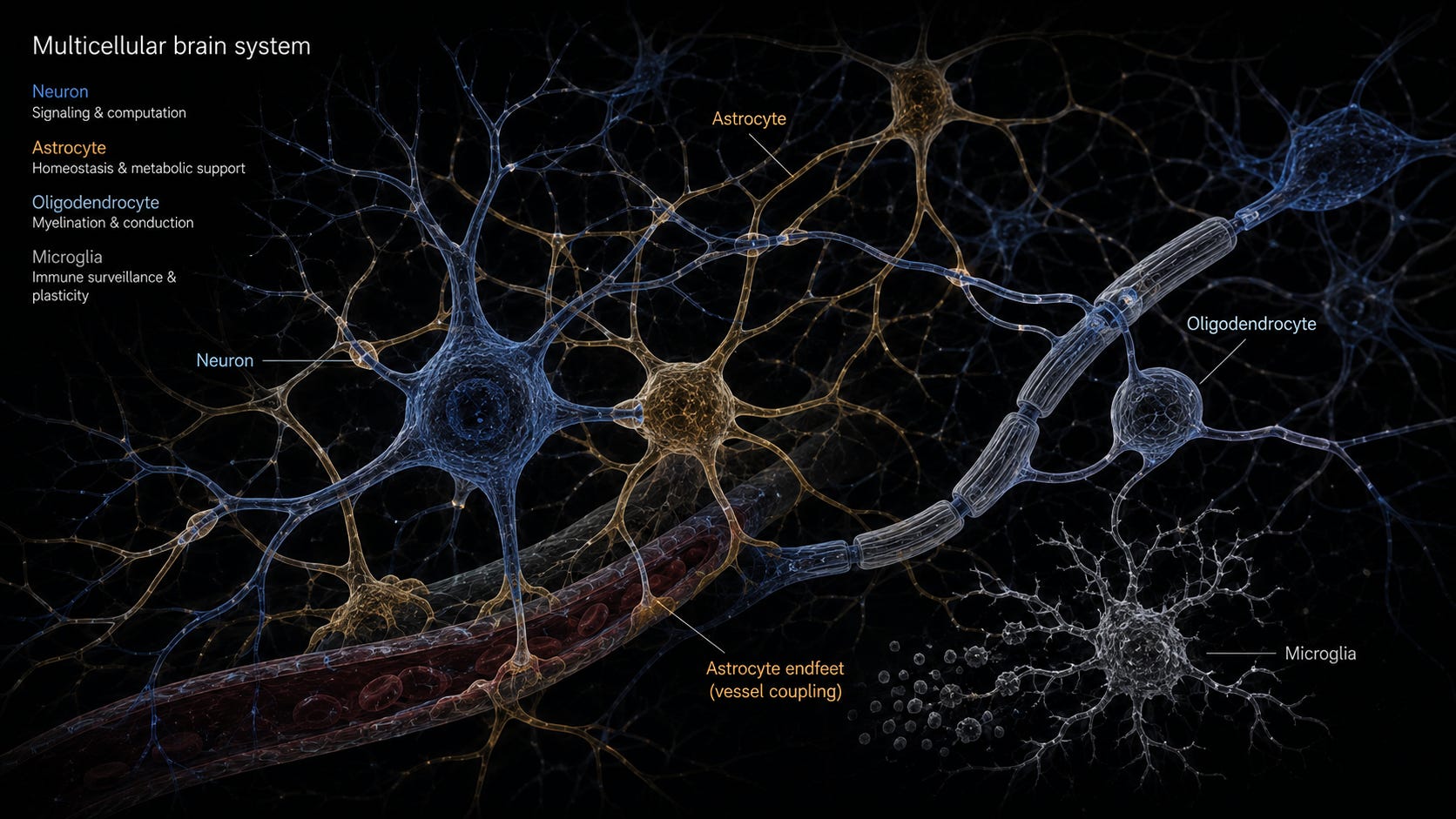
Conceptual illustration of the brain as a multicellular system. Neurons, astrocytes, oligodendrocytes, and microglia each contribute to brain function through distinct physiological roles, highlighting that neural computation occurs within a broader cellular ecosystem.
Astrocytes regulate extracellular ions, neurotransmitter conditions, synaptic plasticity, metabolic supply, blood flow, and network excitability. Oligodendrocytes alter conduction through activity-dependent myelination. Microglia prune synapses, respond to injury, and change state during development and disease.
The unresolved question is whether glia perform computations in a meaningful sense or whether they regulate and constrain computations carried out primarily by neurons. That distinction should not be settled by metaphor. Astrocytic calcium signaling may carry functionally significant information, but its interpretation remains debated.
Evidence of spatially organized and plastic astrocytic networks, together with work showing network-level patterns in astrocytic signaling, makes the old “support cell” model increasingly difficult to defend without yet establishing a complete theory of glial computation. (Nature)
The brain is better understood as a multicellular system than as a network of neurons with maintenance cells attached.
Pain, addiction, and the limits of translation
Acute pain serves a protective function. Chronic pain can persist after healing, continue without a clear ongoing injury, or become disproportionate to identifiable tissue damage. This is not adequately explained by saying that the pain is psychological or imaginary. The experience is real even when its relationship to current tissue injury has changed.
Proposed mechanisms include peripheral sensitization, spinal plasticity, descending modulation, immune and glial activity, learning, expectation, emotion, and large-scale network changes. The central unsolved question is why protective pain resolves normally in some people but becomes a self-sustaining pathological state in others.
Addiction is often described as a disorder of reward. That is incomplete. Compulsive use involves interactions among reward learning, incentive salience, habit, withdrawal, stress, memory, environmental cues, executive control, and social conditions.
The most difficult questions concern individual trajectories: why some exposed individuals develop compulsive use while others do not, why craving can return after years of abstinence, and which observed neural changes cause addiction rather than reflecting compensatory responses or consequences of repeated use. There is no complete model that predicts progression, remission, and relapse at the level of an individual person.
Animal models remain indispensable, yet they usually model selected components of a human disorder rather than the complete causal system. Translation can fail because of species differences, artificial disease induction, genetic homogeneity, laboratory endpoints, publication bias, timing, dose, and the heterogeneity of human diagnoses. A model may resemble the symptoms of a disease without reproducing its cause.
Clinical translation can also fail because the therapeutic target was wrong, dosing was inadequate, participants were poorly selected, or treatment began too late.
A 2024 umbrella review of 367 therapeutic interventions estimated that approximately 50 percent progressed to at least one human study, 40 percent reached randomized controlled trials, and 5 percent ultimately obtained regulatory approval. The study also found substantial concordance between positive animal and clinical findings, illustrating that translation is neither simple failure nor automatic success. Confidence in a claim must be updated as evidence crosses successive tests. (PLOS)
Energy constrains every neural theory
The brain has a finite energy budget. Action potentials, synaptic transmission, neurotransmitter recycling, ion-gradient restoration, maintenance, and plasticity all consume energy.
A theory of neural coding that ignores metabolic cost is incomplete. The brain cannot maximize information transmission without regard to energy use. It must trade speed, reliability, precision, redundancy, and flexibility against limited resources.
This raises fundamental questions. Does energy efficiency explain sparse coding? How are metabolic resources divided between neurons and astrocytes? How is blood flow matched to local computational demand? Why are some neuron populations more metabolically vulnerable than others? How do aging and disease disrupt energy coordination?
Energy supply is not an unlimited background resource. It is part of the computation’s physical constraint system.
The landscape of unsolved problems
The field faces dozens of distinct but interconnected open problems. They include neural coding and computation; the gap between structure and function; causality in distributed systems; scaling from molecules to cognition; the empirical and hard problems of consciousness; perceptual construction and the binding problems; multisensory integration; motor planning and cerebellar error correction; learning rules, engrams, synaptic tagging, consolidation, and forgetting; language acquisition and its neural implementation; interoception, agency, and the self-model; placebo and nocebo effects; functional neurological symptoms; development and sensitive periods; plasticity versus stability; individual variability; selective vulnerability in neurodegeneration; mechanisms of mental illness; repair and recovery; brain-computer interfaces; measurement and observability; decoding versus understanding; modeling whole circuits; naturalistic behavior; theory discrimination; reproducibility; neuroethics; sleep and dreaming; glial participation in computation; chronic pain; addiction; the animal-to-human translation gap; general anesthesia; the effects of sex and reproductive hormones; circadian timing; gut-brain signaling; and the energetic constraints on neural computation.
These are not isolated mysteries. They converge on one deeper problem.
The central unsolved problem
The deepest recurring gap in neuroscience is the transition from observation to explanation
anatomical map → activity pattern → represented information → causal computation → behavior → reliable intervention
Neuroscience has become increasingly powerful at mapping and decoding. Its hardest remaining task is establishing mechanistic accounts that explain how biological components jointly produce function, remain predictive under causal perturbation, generalize beyond one task or laboratory, predict individual behavior and disease trajectories, and support safe restoration when the system fails.
The nervous system is not merely a collection of neurons or a static wiring diagram. It is a developing, embodied, adaptive, recurrent control system whose components continually change while preserving enough organization to perceive, remember, act, and remain alive.
Nor can it be explained solely as a neuronal information-processing network. It is a sleeping, timed, metabolically constrained, hormonally modulated, immune-coupled, glia-integrated organ embedded in a living body. Most of what we know about it comes through imperfect models and indirect measurements rather than direct access to its complete state.
A complete theory of the nervous system must answer to all of those constraints. The central scientific challenge is not simply to catalog the brain’s parts. It is to explain how a continually changing biological system preserves enough causal organization to remain functional across levels, timescales, bodily states, and disturbances.
If you enjoyed this article, please like, share, and subscribe to help more people find the work.
You can also support OmniLens directly here
Every share, subscription, and contribution helps us continue producing careful, evidence-first work.
Thank you 🩷🩵
This was awesome B!